The State of the U.S. Real Estate Market in 2026: What Buyers, Sellers, and Investors Need to Know

The U.S. real estate market in 2026 is moving through an important period of transition. After several years of unusually low inventory, rapidly changing mortgage rates, strong home-price growth, and significant affordability challenges, the housing market is gradually becoming more balanced.
For buyers, this changing environment can provide more choices and opportunities to negotiate. For sellers, it means that simply putting a property on the market at any price may no longer be enough to attract serious buyers. Investors, meanwhile, are paying closer attention to local market conditions, rental demand, financing costs, and long-term economic trends.
One of the most important things to understand about the 2026 housing market is that there is no single market representing the entire United States. Conditions can be dramatically different from one state, city, or neighborhood to another.
So, what does the U.S. real estate market actually look like in 2026? And what should buyers, sellers, homeowners, and investors know before making their next move?
A Housing Market Moving Toward Balance
The U.S. housing market has spent much of the past several years dealing with a supply-and-demand imbalance. A shortage of available homes gave sellers considerable negotiating power, particularly in highly desirable markets.
That environment has gradually changed.
More homes are now available for buyers to consider, giving purchasers greater choice than they had during the most competitive periods of the pandemic-era housing market. Realtor.com reported that active inventory continued to grow in 2026, while the number of homes for sale remained above one million nationally during parts of the summer.
The improvement in inventory does not mean that housing is suddenly abundant everywhere. Supply remains highly dependent on location, price range, and property type.
Some markets still have limited inventory and strong demand. Others are experiencing more noticeable price adjustments and longer selling periods.
This difference is increasingly important for anyone participating in the market.
Instead of asking whether the U.S. housing market is a "buyer's market" or "seller's market," it is more useful to ask what is happening in the specific market where a property is located.
Home Prices Are Still High, But Price Growth Has Slowed
Home prices remain one of the biggest challenges for American buyers.
According to the National Association of Realtors, the median existing-home price reached $431,400 in July 2026, while inventory stood at approximately 4.6 months of supply.
However, the national picture becomes more complicated when looking at listing prices and regional differences.
Realtor.com's July 2026 housing data showed that the national median list price declined 2.4% year over year. Listing prices declined in the West, South, and Northeast, while the Midwest recorded a small increase.
This illustrates an important point: slowing price growth does not necessarily mean that homeowners are suddenly losing substantial value.
Instead, the market is experiencing a period of normalization.
Realtor.com's updated 2026 forecast expects existing-home prices to increase approximately 1.2% by the end of the year, significantly slower than the original forecast of 2.2%.
For buyers, slower price growth can create a little more breathing room. For sellers, it emphasizes the importance of realistic pricing and understanding local comparable properties.
Mortgage Rates Continue to Shape Buyer Decisions
Mortgage rates remain one of the most influential factors in the housing market.
For many buyers, the biggest obstacle is not necessarily the price of the home itself but the monthly payment created by the combination of home price, interest rate, property taxes, insurance, and other housing expenses.
Realtor.com's 2026 midyear forecast projects an average mortgage rate of approximately 6.3% for the year.
While this is lower than some of the levels seen during previous periods of elevated rates, it is still considerably higher than the exceptionally low mortgage rates available to many homeowners earlier in the decade.
This has created what is sometimes called the "lock-in effect."
Homeowners who secured very low mortgage rates may be reluctant to sell because moving would require them to take out a new mortgage at a significantly higher rate.
That can restrict the supply of existing homes.
At the same time, potential buyers are carefully calculating what they can afford. A buyer who qualified for a particular home several years ago may have significantly different purchasing power today because of changes in interest rates.
This is why mortgage rates can influence housing demand even when home prices themselves are relatively stable.
Inventory Is Giving Buyers More Options
One of the most encouraging developments for buyers is the gradual improvement in inventory.
For years, buyers often faced situations where multiple people were competing for the same property. In some markets, buyers had to move quickly, offer above asking price, or make concessions simply to remain competitive.
The current environment is different in many parts of the country.
Realtor.com's July 2026 data showed that active inventory remained above the previous year's level, while the typical home spent about 57 days on the market.
More inventory gives buyers the ability to compare properties instead of feeling pressured to purchase the first suitable home they find.
It can also create opportunities for negotiation.
A buyer may have more room to request repairs, negotiate the purchase price, consider seller concessions, or take additional time to evaluate the property.
However, buyers should not assume that every seller is willing to negotiate heavily. Desirable homes in sought-after neighborhoods can still attract significant attention.
The key is understanding the local market rather than relying entirely on national headlines.
The Market Is Becoming Increasingly Regional
One of the most important characteristics of the 2026 U.S. housing market is how different regions are performing.
The Midwest and Northeast have generally benefited from relatively stronger affordability compared with some expensive Western markets. Realtor.com has identified several Midwestern and Northeastern markets as attractive because they combine housing value with economic and employment opportunities.
Meanwhile, some markets in the West and South have experienced more significant price adjustments.
Realtor.com's June 2026 data showed that asking prices had fallen from their 2022 peak in the West and South, while prices were higher than the 2022 peak in the Midwest and Northeast.
These differences can be caused by many factors, including:
-
Local employment conditions
-
Population growth
-
Housing construction
-
Mortgage affordability
-
Property taxes
-
Insurance costs
-
Climate and weather risks
-
Availability of land
-
Local regulations
-
Migration patterns
-
Household income
As a result, national statistics should be treated as a starting point rather than a complete picture.
A homeowner in Boston may have a very different experience from a homeowner in Austin. A buyer in Chicago may encounter completely different conditions from one in Los Angeles.
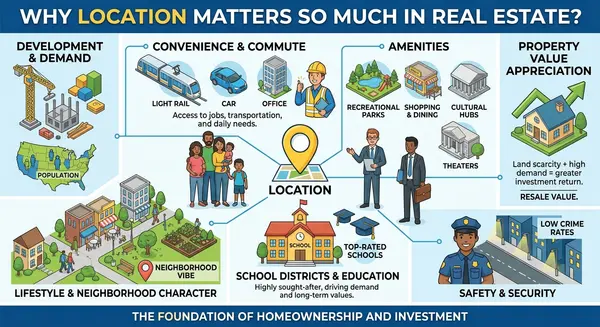
Real estate is local.
What the 2026 Market Means for Homebuyers
For buyers, 2026 can offer opportunities that were more difficult to find during the most competitive years of the housing market.
More inventory means more choices. Slower price growth can make it easier to compare properties without feeling that prices will immediately move beyond reach.
However, buyers still need to be financially prepared.
Before beginning the home search, it is important to understand the total monthly cost of ownership. This includes the mortgage payment, property taxes, homeowners insurance, HOA fees when applicable, utilities, maintenance, and potential repairs.
Getting pre-approved for a mortgage can also help buyers establish a realistic budget.
Most importantly, buyers should avoid purchasing more home than they can comfortably afford simply because a lender approves a higher amount.
A home is a long-term financial commitment. The goal should not simply be to qualify for the largest possible mortgage. The goal should be to purchase a home while maintaining financial stability.
What the Market Means for Sellers
Sellers are also entering a market that requires a more strategic approach.
During highly competitive periods, some properties could attract significant attention simply because there were very few alternatives available.
That is becoming less reliable.
When buyers have more choices, presentation and pricing become increasingly important.
A seller should understand recent comparable sales and competing listings before deciding on an asking price. Pricing significantly above the market can result in fewer showings, longer time on the market, and eventual price reductions.
Home preparation can also make a difference.
Simple improvements such as decluttering, cleaning, repairing visible problems, improving curb appeal, and presenting the property professionally can help create a stronger first impression.
Professional photography and effective online marketing are equally important because many buyers begin their search digitally.
A property may receive its first impression online long before a potential buyer enters the front door.
What Investors Should Watch in 2026
Real estate investors are facing a different set of questions.
Instead of simply asking whether property values will rise, investors need to evaluate whether a property makes financial sense under realistic assumptions.
Mortgage rates affect financing costs. Property taxes and insurance can significantly affect operating expenses. Rental demand determines potential income, while local employment and population trends can influence long-term demand.
Investors should also consider vacancy periods, maintenance, property management, repairs, and unexpected expenses.
A property that looks attractive based only on its purchase price may not necessarily be a strong investment.
Successful investors typically evaluate the entire financial picture.
This includes expected rental income, operating expenses, financing costs, potential appreciation, and the investor's own risk tolerance and investment timeline.
Is the U.S. Housing Market Going to Crash?
One of the most common questions in real estate discussions is whether the current market could lead to another major housing crash.
There is no reliable way to predict the future with certainty, but current national data does not by itself indicate that a housing crash is inevitable.
The 2026 market is showing signs of normalization rather than one uniform collapse.
Home sales have been relatively subdued, mortgage rates remain elevated, and some markets have experienced price declines. At the same time, national existing-home prices remain above year-ago levels according to NAR, and inventory has not surged to levels that would automatically indicate a nationwide collapse.
The more realistic scenario may be continued regional differences.
Some markets may experience modest price declines. Others may remain stable, while certain areas could continue to see price growth.
This is another reason why local data is more useful than dramatic national predictions.
Affordability Is Still the Biggest Challenge
Even with improving inventory and slower price growth, affordability remains a major issue.
The combination of high home prices, mortgage rates, property taxes, insurance premiums, and other household expenses can make homeownership difficult for many Americans.
There are, however, some signs of improvement.
NAR reported that its housing affordability index improved in June 2026 compared with the previous year, with improvement across all four major U.S. regions.
This does not mean housing has suddenly become affordable for everyone.
Instead, it suggests that the relationship between household income, home prices, and financing costs is beginning to improve in some areas.
For buyers, even small improvements can matter when combined with increased inventory and slower price growth.
What Should Buyers and Sellers Expect for the Rest of 2026?
The remainder of 2026 is likely to remain highly dependent on mortgage rates, economic conditions, employment, housing supply, and consumer confidence.
Realtor.com's midyear forecast expects mortgage rates to average around 6.3% and existing-home sales to reach approximately 4.10 million for the year.
That points toward a market that is active but far from the extreme conditions seen during the pandemic-era housing boom.
Buyers may continue to benefit from increased inventory and greater negotiating power in many markets.
Sellers may need to price properties more carefully and compete more actively for buyer attention.
Investors may find opportunities in markets where population growth, rental demand, employment, and property values create favorable long-term conditions.
The most important factor will remain location.
Final Thoughts
The U.S. real estate market in 2026 is not simply a buyer's market or a seller's market. It is a market in transition.
Inventory is improving. Price growth is slowing in many areas. Mortgage rates continue to influence purchasing power, while affordability remains a major concern.
At the same time, the market is becoming increasingly regional.
For buyers, this means there may be more opportunities to negotiate and compare properties. For sellers, it means realistic pricing and strong presentation matter more than ever. For investors, careful analysis is essential because rising prices alone should not be the foundation of an investment strategy.
The biggest takeaway is simple: don't make real estate decisions based only on national headlines.
Study the local market. Understand your finances. Look at comparable properties. Consider your long-term goals. And work with qualified real estate and financial professionals when appropriate.
The 2026 housing market may not offer the certainty that buyers or sellers would like, but it does offer something valuable: a market that is gradually giving participants more room to make thoughtful, informed decisions.
Categories
Recent Posts